

Tobacco Endgame: Zero Hazard.Smoke-free Generation
Tobacco use imposes a heavy economic and medical burden on society. It kills more than 8 million people worldwide each year, including more than 1.2 million non-smokers, and costs a sum of US$1.8 trillion in medical expenses and productivity loss due to smoking-related illnesses. In Hong Kong, the related casualties and economic losses are nearly 7,000 people and about HK$5.6 billion per year respectively. Although long-time tobacco control efforts have led to a steady decline in smoking, tobacco products are still allowed to be sold as consumer goods and the tobacco hazards continue to endanger the health of people and the community.
Tobacco control experts forecasted that tobacco use will continue to be the top enemy of public health in the future, and therefore propose different innovative approaches to significantly reduce smoking and its harmful effects, and even further eliminate the tobacco epidemic.
Can we achieve a smoke-free future in Hong Kong? What are the requirements for reaching a smoke-free environment? Watch the following video now.
From "Tobacco Control" to "Tobacco Endgame"
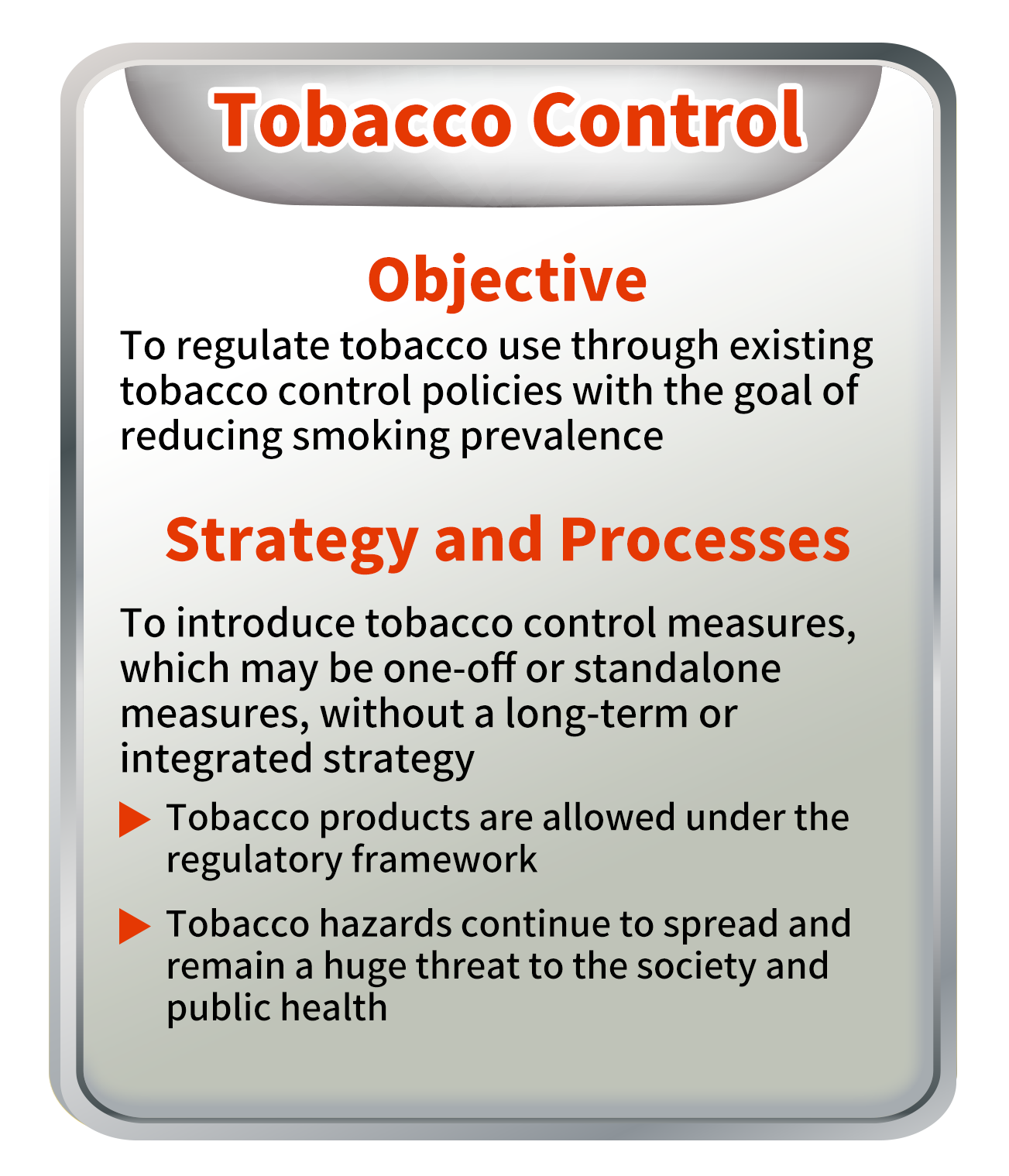
Since the 1950s, numerous independent medical reports have confirmed the harmful effects of smoking and its link to cancers, cardiovascular diseases, respiratory diseases and other serious illnesses, leading governments around the world to launch tobacco control campaigns. With the support of the World Health Organization and its international treaty, WHO Framework Convention on Tobacco Control (FCTC), smoke-free education and publicity have been promoted to the mass public and tobacco control legislations such as restricting the sale and promotion of tobacco products, raising tobacco taxes, establishing statutory no-smoking areas, and regulating tobacco packaging, etc. have been enacted worldwide to curb the spread of tobacco and its harms.
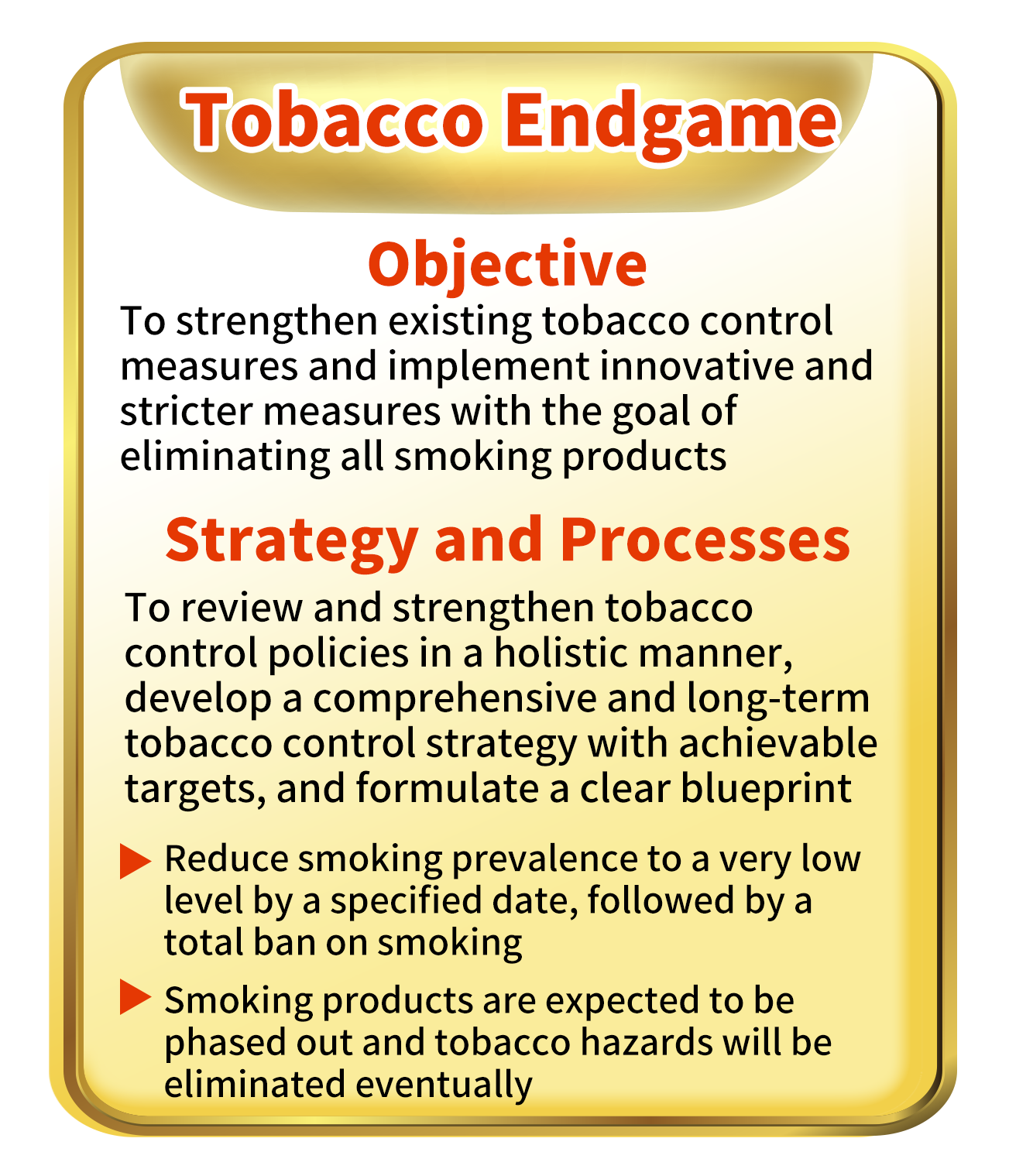
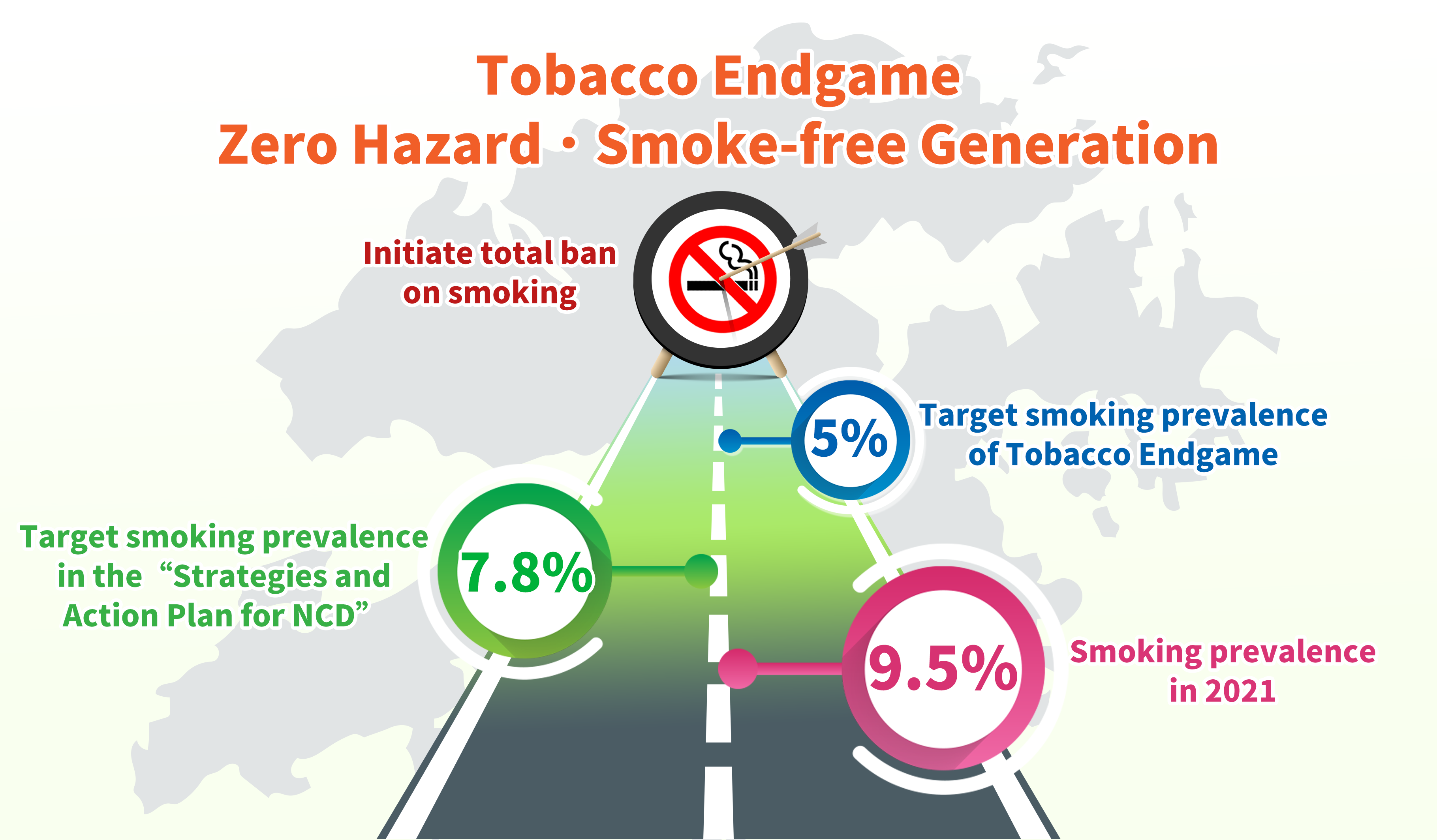
With remarkable efforts of tobacco control and the smoke-free measures implemented in the early years, some developed countries recorded a significant reduction in smoking rates to a comparatively low level. Some public health experts then initiated the concept of "Tobacco Endgame”. Instead of “controlling tobacco harms” continuously without an endpoint, "Tobacco Endgame" is a more advanced and forward-looking concept that aims to reduce smoking prevalence and phase out tobacco products by strengthening tobacco control measures comprehensively, and ultimately terminate the tobacco epidemic. Countries with an endgame plan commonly set 5% of smoking prevalence as a key target and stepping stone for Tobacco Endgame. A total ban on smoking will then be initiated after achieving the target.
How to implement the Tobacco Endgame?
There is no single standard or designated approach or strategy for a Tobacco Endgame. Dr Margaret CHAN, former Director-General of the World Health Organization, pointed out that in formulating the endgame plan, it is necessary to recognize the diversity of factors that drive the tobacco epidemic in different economic and cultural contexts and to avoid these factors hindering the implementation of the plan. To address different contexts, it may be necessary to consider a diversity of endgame strategies, rather than adopting a single global strategy. Whatever the strategy is, stricter and more sophisticated methods to existing tobacco control measures as well as innovative, ground-breaking measures are needed to reduce smoking rates effectively and sustainably.
Some tobacco control experts have consolidated the relevant academic discussions on the endgame and classified the revolutionary measures that could lead to a Tobacco Endgame into the following four categories:
- Product-focused strategies, such as regulating nicotine to less/non-addictive levels and banning flavours that make tobacco products more tolerable or palatable
- User-focused strategies, such as smoker license system for purchasing tobacco products and banning tobacco sales to people born after a specific year
- Market/supply-focused strategies, such as “sinking lid” strategy that restricts tobacco supply on a regular basis
- Institutional structure-focused strategies, such as levy on tobacco manufacturers to fund tobacco control initiatives
Some countries have already set a timetable for Tobacco Endgame, with the goal of reducing smoking rates to 5% or less by a target year. For example, New Zealand plans to reduce smoking prevalence to 5% by 2025 and has launched the Smokefree Aotearoa 2025 Action Plan to achieve it. Some of the stringent and innovative measures that are already implemented or being proposed include a substantial annual increase in tobacco tax, plain packaging that removes all branding elements on cigarette packs, as well as forthcoming policies such as reducing the number of authorized tobacco retailers and reducing nicotine content in smoking products. Among these, the Smoke-free Generation Policy will be the first in the world and worth attention. It proposes to ban the sale of tobacco to people aged 14 or below from 2023 and increase the legal age each year, as such future generations will be lifelong kept away from smoking and its hazards.
Countries with a plan to reach the Tobacco Endgame
|
Countries |
Smoking prevalence in 2019* |
Target smoking prevalence |
Target date |
|
Ireland |
19.6% |
< 5% |
2025 |
|
New Zealand |
13.6% |
< 5% |
2025 |
|
Sweden |
11.6% |
< 5% |
2025 |
|
Finland |
17.0% |
< 5% |
2030 |
|
United Kingdom |
13.9% |
≤ 5% |
2030 (England); |
|
Canada |
12.9% |
< 5% |
2035 |
|
Netherlands |
19.5% |
< 5% |
2040 |
|
Malaysia |
18.2% |
< 5% |
2045 |
*Source: WHO report on the global tobacco epidemic 2021
How close is Hong Kong to a Tobacco Endgame?
The year 2022 marks the 40th anniversary of the enactment of the Smoking (Public Health) Ordinance in Hong Kong since 1982. Over the past decades, the Government has adopted a multi-pronged approach to promote tobacco control, including legislation, publicity, education, and promotion of smoking cessation. According to the Thematic Household Survey Report No. 75 published by the Census and Statistics Department in May 2022, the smoking prevalence in Hong Kong has gradually decreased from 23.3% in the early 1980s to 9.5% in 2021, which is lower than most of the countries that have drawn up their endgame plans.
In 2021, Hong Kong passed the legislation to prohibit the import, promotion, manufacture, sale and possession for commercial purposes of alternative smoking products, including e-cigarettes, heated tobacco products and herbal cigarettes. It marked an important milestone in Hong Kong tobacco control development. The ban effectively prevents the spread of alternative smoking products and the re-emergence of smoking and its hazards in alternative forms. Foreign experience has shown that the tobacco industry used alternative smoking products to promote and induce smoking, re-normalize smoking behavior among the youth and interfere with existing tobacco control policies which posed a serious threat to public health. The ban on alternative smoking products has cleared one big roadblock for advancing tobacco control and put Hong Kong in an advantageous position over other countries and regions to formulate Tobacco Endgame and achieve a smoke-free environment.
Having experienced the COVID-19 epidemic for two years, Hong Kong people become more health conscious. It is a universal opinion that smoking is not cool and no smoking products can reduce the risk of smoking. A “no smoking” culture is built and more smokers would choose to quit smoking. Among the current smokers in Hong Kong, nearly half (50.6%) are aged 50 or above and three-quarters (75.7%) are aged 40 or above. Many of them have started to quit smoking for health reasons. On the other hand, the smoking rate among young people in Hong Kong is very low. Only 1.2% of secondary school students are currently smoking. As alternative smoking products are already banned in Hong Kong, one of the temptations for young people is removed and the chance of becoming smokers is lower. If Hong Kong continues to step up its efforts to promote smoking cessation among smokers and maintain the very low uptake among young people, a Tobacco Endgame is possible and feasible.
In 2018, the Government launched “Towards 2025: Strategy and Action Plan to Prevent and Control Non-communicable Diseases in Hong Kong”, in which one of the targets is to further reduce smoking prevalence to 7.8% by 2025. However, an official target for tobacco control beyond 2025 is yet to be promulgated. In May 2022, Prof Sophia CHAN, the then Secretary for Food and Health, stated that the Government would work towards a Tobacco Endgame through three aspects, including extending the statutory no smoking areas, reducing the attractiveness of tobacco products and reducing the risk of young people's addiction to smoking.
While it is the Government's obligation to formulate and implement tobacco control policies that are beneficial to the community and protect public health, the understanding and support of all segments of the community also play an important role in pushing toward the Tobacco Endgame. Tobacco is not just a health issue, but also cause negative impact on issues related to the society, economies, environment, quality of life, etc. Therefore, everyone in society can contribute to the implementation of the Tobacco Endgame. For example, parents should set an example by not smoking and educate their children on the harmful effects of smoking; employers can provide and maintain a smoke-free working environment and encourage their employees to quit smoking; the media, education, medical and social sectors should explicitly refuse partnership or sponsorship from tobacco companies and their related organizations, etc. By achieving Tobacco Endgame, we can save up to 7,000 lives and prevent economic losses of up to HK$5.6 billion per year in Hong Kong. This money saved could be reallocated to socio-economic measures, thus benefiting the whole community.
In order to root out the tobacco epidemic, the Government must set a clear target, roadmap and comprehensive strategies for a Tobacco Endgame as soon as possible. Publicity and education should also be carried out to enhance public awareness of the strategies and directions of Tobacco Endgame, so as to garner wider public support and join hands to achieve a " Zero Hazard.Smoke-free Generation".
Related information:
- Tobacco Control Strategies: Tobacco Endgame
- News: New Zealand's further step to Tobacco Endgame - A smoke-free generation