


The Trap of Nicotine Addiction
The dangers of smoking have been long established. But why do people still try smoking and are unwilling to quit this harmful habit? Is smoking just a personal choice of smokers?
Tobacco contains thousands of chemicals, among which nicotine is a highly addictive substance that changes the brain circuits, making smokers dependent on nicotine and causing damage to the body. Many smokers were not aware of its addictiveness and believed that they could control themselves from being addicted when they first started smoking. They might take the first puff for various reasons, but once they become hooked on nicotine, they gradually lost the free will to choose not to smoke.
How does nicotine hijack a smoker’s brain? Apart from addiction, what are the negative effects of nicotine on the body? How do tobacco companies deliberately manipulate the nicotine content in smoking products to reinforce smokers’ dependence on nicotine?
Watch the video to learn about the pitfalls of nicotine addiction:
Nicotine disrupts natural brain function and causes addiction
When it comes to addiction, most people might think of non-substance addictions such as addiction to gambling, smartphones and shopping. However, substance addiction can be detrimental to physical health and mental health. Nicotine in smoking products, similar to drugs, is a highly addictive substance that biologically alters the way our brain works. It causes users to become addicted unconsciously and poses health risks in the long run.
In the human brain, there are tens of billions of neurons (nerve cells). When a neuron receives a signal called action potential, it triggers the release of neurotransmitters. Each neurotransmitter acts like a key that unlocks a receptor on another neuron, allowing the signal to be transmitted from one neuron to another. The connections between neurons form a complex neural network that transmits signals of emotion, movement and reaction between the brain and various parts of the body to carry out different functions.
The reward system is one of the important neural networks in the brain and is associated with the release of a specific neurotransmitter called dopamine. In a healthy brain, the release of dopamine is self-regulated. When we experience pleasure from certain behaviours or events, such as enjoying delicious food or engaging in social activities, the brain naturally releases dopamine to signify that a memorable event is happening. This motivates us to repeat the same behaviours to seek pleasure.
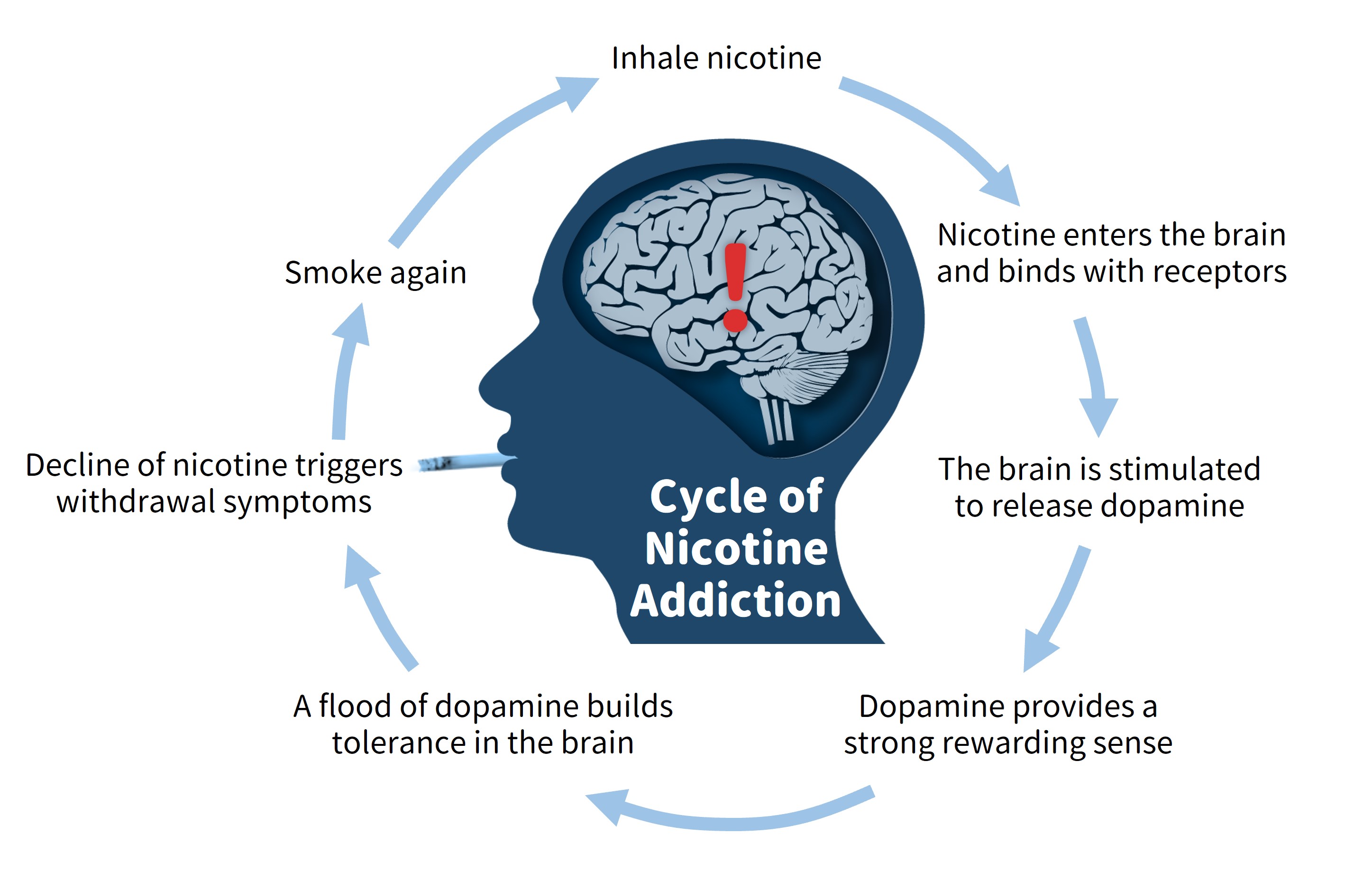
Nicotine addiction process (1): Nicotine hijacks the brain's natural regulatory mechanism
Nicotine, the addictive substance in tobacco, can hijack the brain's self-regulating reward system, interfering with and disrupting the release and reception of dopamine, leading to substance addiction. Nicotine in tobacco is absorbed by the lungs and carried to the brain through the bloodstream within seven seconds of smoking. Since the molecular structure of nicotine is similar to that of the neurotransmitter acetylcholine, nicotine can unlock acetylcholine receptors in the brain and stimulate neurons to release several neurotransmitters, including a significant amount of dopamine. A sense of reward is triggered by the stimulation of nicotine, the external substance (instead of the natural release of dopamine by the body). It makes smokers feel temporarily happy and relaxed, and thus creates the misconception that smoking is gratifying and stress-relieving.
Nicotine addiction process (2): The brain builds tolerance to nicotine
As smokers continue to smoke, the number of nicotinic acetylcholine receptors in the brain gradually increases, leading to an increased craving for smoking and nicotine. Over time, due to the continuous release of dopamine which is stimulated non-naturally by nicotine, the brain develops tolerance and loses the ability to innately regulate. As a result, smokers will have difficulties in experiencing natural pleasure in the absence of nicotine, therefore crave for consuming more nicotine.
Nicotine addiction process (3): Nicotine dependence forms withdrawal symptoms
The nicotine levels in smokers’ bodies gradually decrease when they stop smoking, and withdrawal symptoms occur. Smokers may experience strong cravings for smoking, anxiety, irritability, restlessness, difficulty concentrating, low mood, sadness, anger, hunger, insomnia, etc. These symptoms prompt smokers to seek nicotine again to satisfy the needs of the brain.
The above process is how nicotine controls the smoker's brain, leading to a vicious cycle of nicotine addiction.
Diagnosing Nicotine Addiction
Nicotine changes the way the brain works, making it one of the most addictive substances in the world. Even a single puff of a cigarette can pose a risk of addiction. In addition to nicotine, factors such as genetic composition, psychological status, social environment, and tobacco use history may have an impact on the level of addiction.
The International Classification of Diseases published by the World Health Organization and the Diagnostic and Statistical Manual of Mental Disorders published by the American Psychiatric Association define nicotine dependence and tobacco use disorder respectively as substance abuse disorder, which is a type of mental illness. Symptoms include strong cravings to smoke, difficulty in controlling smoking despite awareness of its harmful effects on health, tolerance to nicotine, and experience of withdrawal symptoms when stop smoking.
The Fagerstrom Test for Nicotine Dependence is the most commonly used assessment tool for evaluating the level of nicotine dependence. It assesses cigarette consumption, compulsiveness, and dependence through six items, with higher score indicating higher level of dependence.
Nicotine is not just addictive
Nicotine can lead to poisoning
The most common way of nicotine intake is inhalation through the respiratory tract. It can also be absorbed through the oral mucosa, intestines, and skin. Overdosing of nicotine can result in poisoning. Mild nicotine poisoning can cause symptoms such as nausea, vomiting and headaches, while severe cases can lead to difficulty breathing, seizures, cardiac arrhythmias, and even death. According to data from the US National Institute for Occupational Safety and Health, the estimated lethal dose of nicotine for adults is about 50 to 60 milligrams.
Although acute poisoning of adults due to continuous smoking has been uncommon in recent years, there has been an increase in the number of nicotine poisoning cases around the world with the emergence of new smoking products which use liquid nicotine solutions, such as e-cigarettes. Children, in particular, are more vulnerable to excessive nicotine intake because of their smaller bodies. A report released by the US Food and Drug Administration indicated that between April 2022 and March 2023, there were approximately 7,000 cases related to exposure to e-cigarettes or e-cigarette solutions. This represents an increase of over 30% compared to the same period in the previous year. Among all the cases, nearly 90% (87.8%) were children under the age of five, and about 40% of them were related to ingestion or oral exposure to e-cigarettes/e-cigarette solutions.
Nicotine impairs brain development
When we form memories or learn new skills, the neurons in our brains establish stronger connections. The human brain continues to develop until around the age of 25. During development period, the brains of children and adolescents build connections faster than those of adults. But nicotine intake can disrupt neurons form connections, damaging brain regions that control attention, learning, emotion regulation and impulse control. Using tobacco or nicotine products during adolescence can also increase the risk of future addiction to other substances.
Nicotine promotes carcinogenesis even it is not a carcinogen
Nicotinic acetylcholine receptors are found in tissues outside the nervous system. Actions on nicotinic receptors produce a wide variety of acute and long-term effects on organ systems, cell proliferation and cell apoptosis, increasing the risk of cardiovascular, respiratory, and gastrointestinal diseases. Nicotine can also suppress immune responses and have adverse effects on the reproductive system.
Although the International Agency for Research on Cancer has not classified nicotine as a carcinogen, multiple studies have indicated that nicotine acts as a "tumour promoter" and increases the likelihood of developing cancer. Actions on nicotinic receptors can lead to the transformation of normal cells into cancer cells after exposure to carcinogens, affect cancer proliferation and metastasis, and increase resistance to chemotherapy and radiation therapy drugs.
In daily life, the use of smoking products is the primary source of nicotine intake. In addition, different smoking products contain many other chemicals. For example, cigarettes contain over 7,000 chemicals and 70 carcinogens, while e-cigarettes contain formaldehyde, acetaldehyde, polycyclic aromatic hydrocarbons (PAHs), heavy metals, volatile organic compounds (VOCs), etc. Although nicotine itself is not carcinogenic, nicotine addiction poses smokers to serious health risks by prolonged exposure to significant amounts of harmful chemicals.
Generations of deliberately manipulated addiction
Nicotine is a chemical naturally occurring in the tobacco plant. Apart from tobacco leaves, nicotine is also present in nightshade family plants such as eggplants, tomatoes, and potatoes. However, the nicotine content in these plants is far lower compared to cigarettes. When consumed as part of food, the nicotine component digested, broken down, or eliminated and has a minimal likelihood of causing addiction or harm. On the other hand, when nicotine is inhaled through smoking, it enters the body via the respiratory system and circulates through the bloodstream, posing significant health risks and addiction potential.
Nicotine content in fruits, vegetables and cigarettes

The industry has been exploiting the nature of nicotine to sell smoking products globally and earn huge profits. At the beginning of the cigarette epidemic, tobacco companies strenuously denied the addictive properties of nicotine. Even as late as in 1994, tobacco companies gave testimony in a US court hearing that nicotine was not addictive. However, the exposed tobacco industry’s internal documents revealed that tobacco companies were well aware that nicotine addiction was the fundamental reason for smokers to continue using their products. They invested significant resources since the 1950s in researching the effects and impact of nicotine, as well as how to make use of nicotine and cigarettes to induce an effective addiction and establish long-term dependence in smokers.
In the past decade, as the traditional tobacco market has gradually shrunk, tobacco companies have faced significant challenges in profits. They introduced various new smoking products, claiming them to be "less harmful", in order to mislead the public, re-shape smoking and preserve their businesses. In fact, despite the different appearances, compositions, flavours and consumption methods of different smoking smoking products, they share the same addiction tactic, i.e. nicotine. Whether traditional cigarettes, waterpipe tobacco, e-cigarettes, heated tobacco products, cigars or snuff, nicotine is the core component. The tobacco industry shaped some as recreational products, but the sole purpose is to induce nicotine addiction.
The rapid changes in the tobacco or nicotine product market pose significant challenges to global tobacco control. Some countries have failed to implement regulations or ban early on the new smoking products, resulting in the further emergence and epidemic of these products. Governments around the world urgently need to implement stricter and more timely tobacco control measures to prevent tobacco companies from creating new addiction cycles for the next generation through product innovation.
|
Tactics to enhance the addictiveness of smoking products
(1) Controlling nicotine content/delivery in smoking products:
(2) Modifying the nicotine formula in smoking products:
(3) Using additives to increase the addictiveness and attractiveness of smoking products:
(4) Modifying the design of smoking products:
|